On August 20th, SBA published stunning proposed changes to its size standards, replacing the August 2025 proposed rule, discussed here, as well as revised size standards methodology. From time to time, SBA reviews and proposes changes to its size standards and those changes are typically incremental and to adjust for inflation. Tomorrow’s proposed changes are massive and will dramatically reshape how small businesses are determined for federal contracting if finalized.
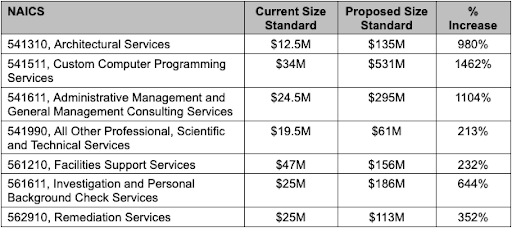
One of the major proposed changes is to shift from revenue to employee-based size standards in many industries. For example, all the construction-related NAICS codes in NAICS Sectors 236 and 237 currently have revenue-based size standards ranging between $19 and $45 million. SBA is now proposing to change all of the construction industries to employee-based size standards, with the new size standards ranging between 550 and 2,000 employees depending on the industry. For example, a firm currently operating in the other heavy and civil engineering construction industry, NAICS code 237990, qualifies as small if its average annual revenue over the past five completed fiscal years is less than $45 million. But under SBA’s new proposal, firms would qualify under the broader Construction NAICS Sector 23713 if their average employees per pay period over the last 24 months is less than 1,500 employees. This means significantly larger and more firms would now qualify as small for construction. In addition, SBA is proposing to change the NAICS level at which size standards are calculated, which will reduce the number of individual size standards. Along these lines, this will also result in SBA removing all size standard exceptions. Currently, many NAICS codes have certain exceptions to size standards for various subindustries. One of these is the exception for NAICS code 541519, Information Technology Value Added Resellers (ITVAR), which currently has a size standard of 150 employees. ITVAR is not addressed directly in the proposed rule, but with the proposed shift to 4- or 5-digit NAICS levels to determine size standards, it appears that the size standard could be changing to $531 million. It is unclear how this will comport with the performance of work requirements for ITVARs performing on set-aside contracts. Another major proposed change is the dramatic increase in most (but not all) of the current revenue-based size standards. To provide a few examples, the table below compares the current and proposed new size standards for several professional services industries. The magnitude of the proposed changes is readily apparent from the percentage increase, the lowest of which reflects an increase of more than 200%. |